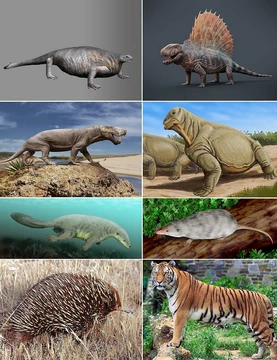
Therocephalia
Extinct therapsids, close relatives of cynodonts and mammals.

Therocephalia is an extinct group of therapsids (mammals and their close extinct relatives) from the Permian and Triassic periods. Named for their large skulls, therocephalians were primarily carnivores and are the group most closely related to the cynodonts, which gave rise to mammals. Conventionally regarded as the sister clade of Cynodontia, together forming Eutheriodontia, some proposals suggest therocephalians may be paraphyletic in relation to cynodonts.
- existed
- Permian and Triassic periods
- classification
- Extinct group of therapsids
- key_relation
- Sister clade of Cynodontia (together Eutheriodontia)
- fossil_rich_region
- Karoo of South Africa, also Russia, China, Tanzania, Zambia, Antarctica
- notable_trait
- Large skulls, carnivorous teeth, some with venomous bite
Lore & Background
Broom's early classification included various genera now recognized as gorgonopsians and even dinocephalians, and he conceived Therocephalia as inherently paraphyletic, giving rise to more advanced therapsid groups.
Reader's Guide
Therocephalia holds significance as the group most closely related to cynodonts, which gave rise to mammals, making them key to understanding therapsid evolution. Their fossils, most numerous in the Karoo of South Africa, support a Gondwanan origin and rapid spread across Pangaea. While most lineages died out during the Permian–Triassic extinction event, a few survived into the Triassic, with only the cynodont-like Bauriamorpha persisting past the Early Triassic. Their extinction by the early Middle Triassic may be due to climate change and competition with cynodonts and archosaurs. Therocephalians exhibit a range of mammalian traits that evolved convergently, including a secondary palate and multi-cusped cheek teeth, and some genera show evidence of a venomous bite, making them the oldest tetrapods known to have evolved this characteristic. Their classification has been historically unstable, with various subgroups and names proposed and later revised.
Did You Know?
- Therocephalians are named after their large skulls, which, along with tooth structure, suggest they were carnivores.
- Some therocephalians, such as Euchambersia, Ichibengops, and Megawhaitsia, have skull structures suggesting they had organs for distributing venom.
- The discovery of maxilloturbinal ridges in the primitive therocephalian Glanosuchus suggests at least some therocephalians may have been warm-blooded.
- Many small therocephalians have small pits on their snouts that probably supported vibrissae (whiskers).
Frequently Asked Questions
What exactly is Therocephalia?
Therocephalia is an extinct lineage of therapsids — the broader group that includes mammals and their closest non-mammal relatives — that thrived during the Permian and Triassic. The name comes from their characteristically oversized skulls and toothy, meat-eating jaws.
How does Therocephalia connect to the origin of mammals?
Therocephalians are conventionally placed as the sister group to Cynodontia, the clade that ultimately produced mammals, and together the two form the radiation known as Eutheriodontia. Because of that close branching relationship, therocephalians are often described as the 'next-door neighbors' of the mammal line.
Where do paleontologists find the best Therocephalia fossils?
The Karoo Basin in South Africa is the richest single source of therocephalian remains, though specimens have also turned up in Russia, China, Tanzania, Zambia, and even Antarctica. That wide geographic spread shows the group was a globally successful carnivore across the late Paleozoic and early Mesozoic.
What made Therocephalia different from other Permian carnivores?
Beyond their notably large skulls and robust carnivorous dentition, some therocephalians appear to have possessed a venom-delivery system, making them one of the few non-reptile groups with that trait. Their combination of size, bite force, and possible venom made them apex predators in their ecosystems.
Is Therocephalia a single, neatly defined family?
Not quite — while most textbooks treat Therocephalia as a valid clade sister to Cynodontia, some researchers have argued the group may actually be paraphyletic, meaning cynodonts could have nested within it. That taxonomic debate keeps the exact boundaries of 'Therocephalia' an open question in synapsid research.
More in Prehistoric Synapsids 1-19
Spotted an error? Know more?
This is a living reference — every entry is fact-audited, and reader corrections feed straight into our audit queue. Suggest an edit · See this site's audit record