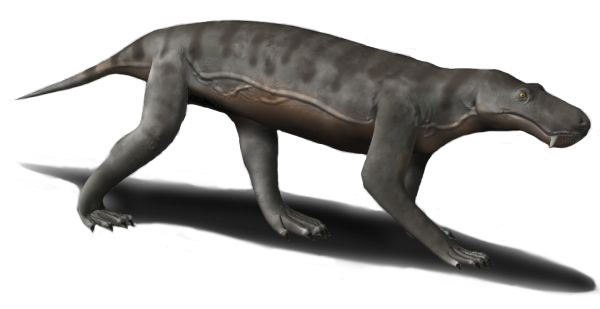
Gorgonops
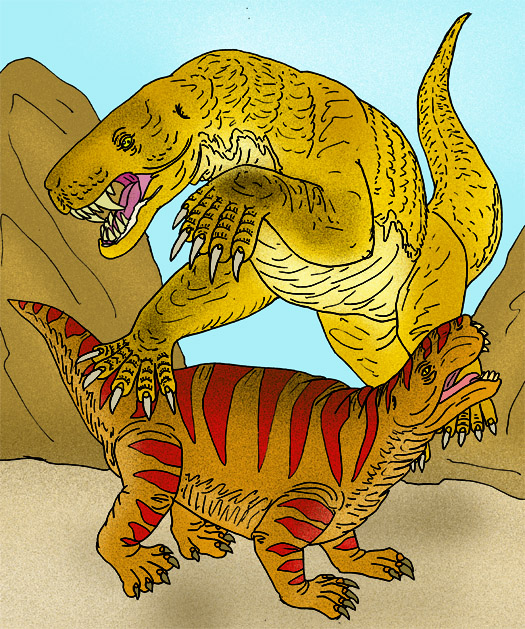
A saber-toothed therapsid predator of the Late Permian.

User:Slate Weasel · Public domain
Gorgonops is an extinct genus of gorgonopsian therapsid, the type genus of its group. The holotype of the type species, Gorgonops torvus, was one of the first therapsids discovered and was described by Richard Owen, who also coined the name 'Dinosauria'.
- found_in
- South Africa
- type_species
- Gorgonops torvus
- skull_length
- 22–35 cm (8.7–13.8 in)
- body_length
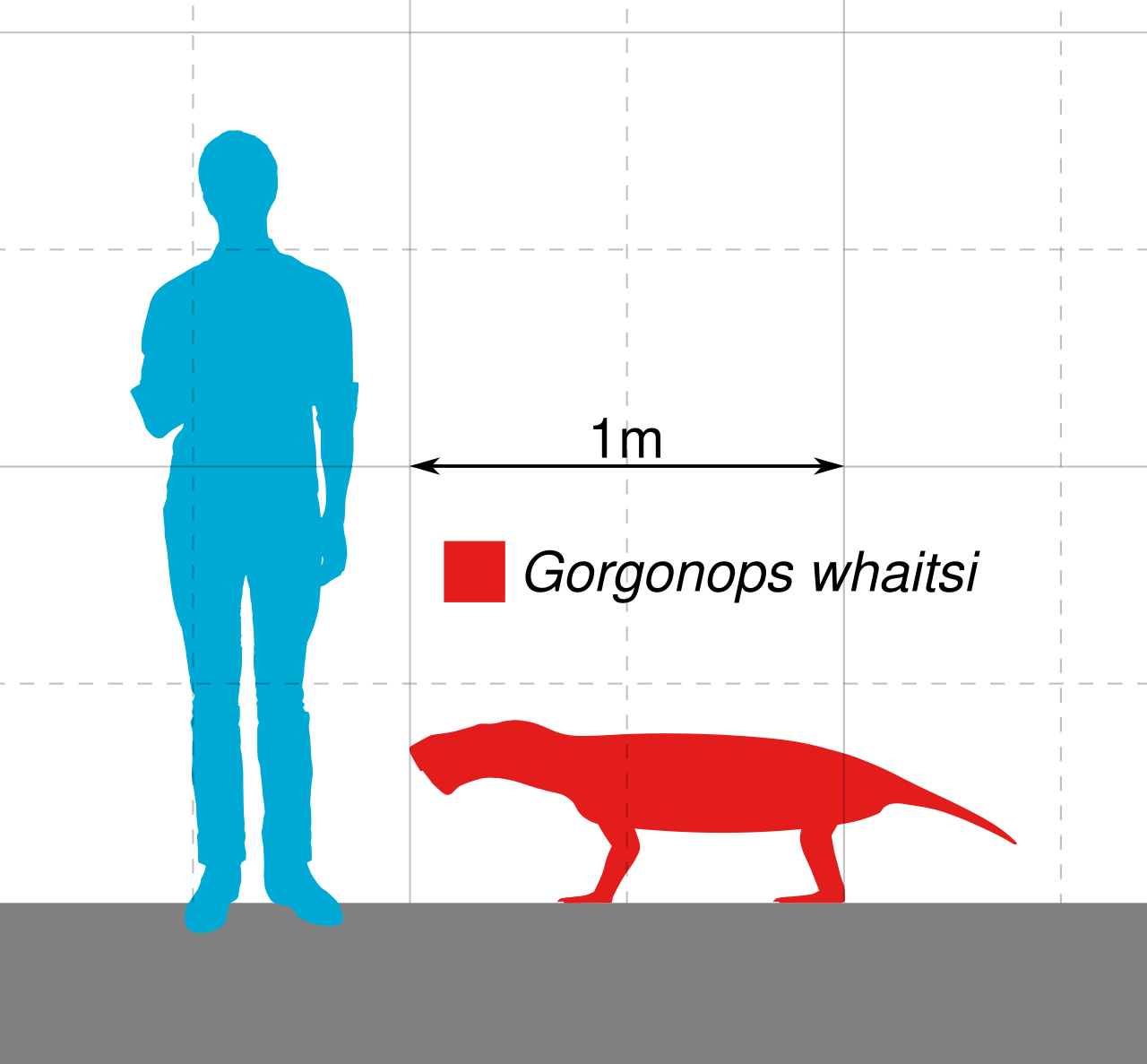
- 1.2–2 m (3.9–6.6 ft)
- key_feature
- Enlarged canine teeth up to 12 cm (4.7 in) long
Lore & Background
Gorgonops was a medium-sized gorgonopsian, with a skull length of 22–35 centimetres depending on the species. It ranged from 1.2–2 metres long from nose to tail. It would have been one of the key predators across southern Africa during the Late Permian. Its large canine teeth would have had little trouble penetrating the tough hides of herbivores like pareiasaurs. A key predatory advantage was its semi-erect gait, compared to the sprawling gait of most prey animals, allowing for more energy efficient locomotion and relatively high speeds.
Reader's Guide
Gorgonops is significant as the type genus of the Gorgonopsia, a major clade of therapsids that dominated Late Permian ecosystems. Its discovery by Richard Owen, who also named the Dinosauria, links it to the early history of paleontology. The genus shows adaptations convergent with Cenozoic saber-toothed cats, such as enlarged canines and protective lower jaw flanges. Multiple species have been described, though some are disputed or considered synonyms. Gorgonops is known from the Tropidostoma and most of the Cistecephalus Assemblage Zones, providing a window into Permian predator-prey dynamics. Its semi-erect gait represents an evolutionary step toward more efficient terrestrial locomotion.
Did You Know?
- The name Gorgonops means 'Gorgon eye' or 'Gorgon face' from Greek.
- Its canine teeth were up to 12 cm long and almost protruded beyond the lower jaw.
- The lower jaw had a thickened front portion to protect the canines, similar to saber-toothed cats.
- Gorgonops torvus was one of the first therapsids ever discovered.
Naming & Taxonomic Legacy
The name Gorgonops carries a striking etymological weight, drawn from the Greek words for "Gorgon" and "eye" or "face," evoking the mythological creature's terrifying visage. This therapsid genus holds a distinguished place in the history of paleontology, as its holotype was among the very first therapsid fossils ever brought to scientific attention. Richard Owen, the same naturalist who would later coin the term "Dinosauria" from the first recognized dinosaur fossils, originally described the type species Gorgonops torvus in 1876. The genus quickly became a linchpin for broader classification: in 1890, Richard Lydekker designated G. torvus as the type species for the family Gorgonopsidae, and five years later, Harry Govier Seeley leveraged the genus to formalize the entire clade Gorgonopsia. Over the following decades, numerous additional species and genera were proposed under or alongside Gorgonops, though many of these taxonomic additions were subsequently recognized as synonyms, underscoring how early paleontologists were still learning to parse the diversity of these Late Permian predators.
Anatomy of a Late Permian Apex Predator
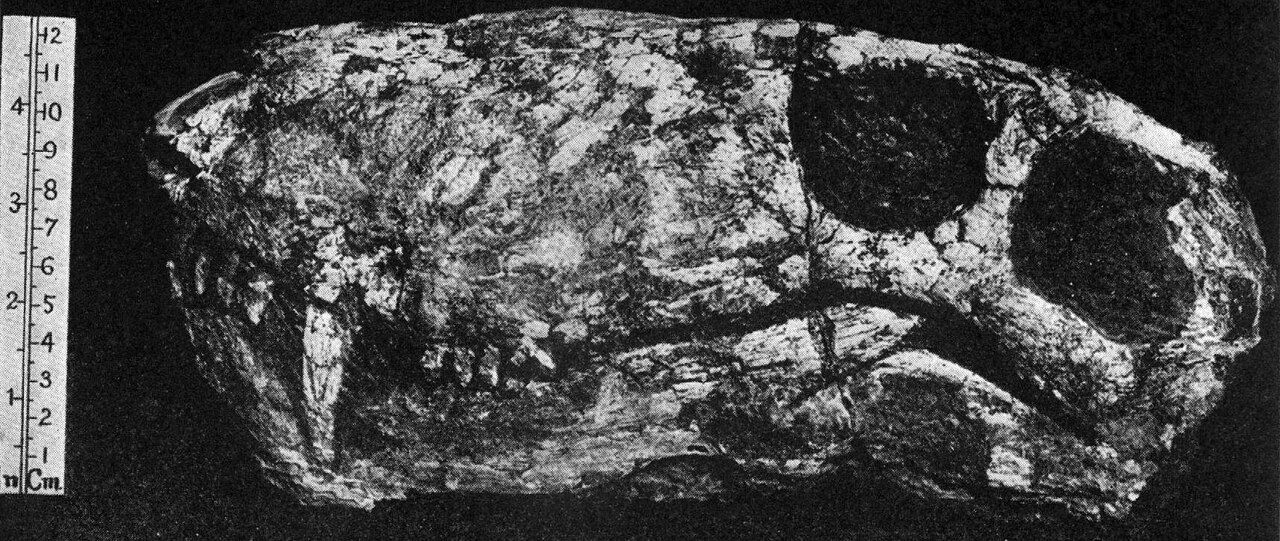
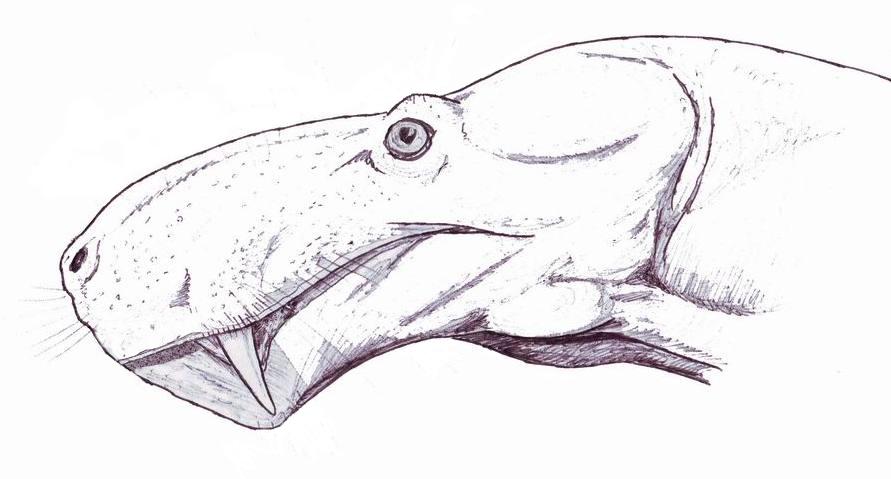
Gorgonops occupied the top of the food chain across southern Africa during the Wuchiapingian stage, roughly 260 to 254 million years ago. As a medium-sized therapsid, it measured between 1.2 and 2 metres from snout to tail, with a skull ranging from 22 to 35 centimetres in length depending on the species. Viewed from above, the skull presented a deep, triangular silhouette. Its most arresting feature was a pair of massive canine teeth, each reaching 12 centimetres in length, so large that they nearly extended past the lower jaw. To shield these vulnerable weapons, the front portion of the mandible was reinforced with thicker bone, a structural solution functionally analogous to the bony flanges seen in Cenozoic sabre-toothed cats. Beyond its dentition, Gorgonops possessed a semi-erect gait that set it apart from the sprawling locomotion of most contemporary herbivores. This posture granted it both greater energy efficiency and the capacity for relatively high-speed pursuit, making it a formidable hunter capable of breaching the tough hides of large pareiasaurs.
Species Diversity and Taxonomic Tangle
The genus Gorgonops has accumulated a complex web of species designations and synonyms over more than a century of study. The type species, G. torvus, was originally described from an incomplete, flattened skull recovered at Mildenhall's farm near Fort Beaufort in the Eastern Cape, and is distinguished by a relatively longer snout. G. whaitsi, first named as Scymnognathus by Broom in 1912, is larger with a broader posterior skull, and has been variously placed in separate families or the same genus depending on the researcher. G. longifrons, described by Haughton in 1915 from a 35-centimetre skull, features a larger orbit and elongated snout, and may have evolved from G. whaitsi. Two additional species, G. eupachygnathus and G. dixeyi, carry question marks over their generic placement, with the former likely representing a juvenile and the latter recovered from Nyassaland with uncertain zone placement. G. kaiseri, from an earlier assemblage zone, displays a high snout and narrower rear. Synonyms include Scymnognathus, Gorgonognathus, Leptotrachelus, Chiwetasaurus, and Pachyrhinos.
Ecological Dominance in the Karoo
During the Late Permian, Gorgonops reigned as one of the principal predators across the landscapes of what is now South Africa. Its fossil record is concentrated in the Tropidostoma and Cistecephalus Assemblage Zones, with specimens recovered from localities including the Eastern Cape and the Karoo Basin around Beaufort West. As an apex carnivore, it preyed upon large-bodied herbivores, particularly pareiasaurs such as Pareiasaurus, whose thick hides posed a challenge to less specialized hunters. Gorgonops's enormous canines, combined with the reinforced anterior mandible, gave it the mechanical advantage to puncture such defences effectively. Its semi-erect posture further distinguished it ecologically: while most of its prey moved with a sprawling gait, Gorgonops could travel at relatively high speeds with greater energy efficiency, turning pursuit into a viable hunting strategy. The genus is known exclusively from the Wuchiapingian stage, placing it firmly in the Late Permian before the mass extinction that would reshape terrestrial ecosystems. Its status as the type genus of Gorgonopsia underscores its foundational role in our understanding of this entire lineage of therapsid predators.
Gallery

Frequently Asked Questions
What is Gorgonops?
Gorgonops is an extinct genus of gorgonopsian therapsid from the Late Permian and serves as the type genus for its entire group. It was a saber-toothed predator that roamed the ancient landscapes of southern Africa.
What made Gorgonops's skull so distinctive?
Its most eye-catching feature was a pair of enormously enlarged canine teeth that could grow to about 12 cm (roughly 4.7 inches) long. Those sabers occupied a striking share of a skull that measured only 22 to 35 cm in total length.
Where and when did Gorgonops live?
Fossils of Gorgonops have been recovered from South Africa, and the animal inhabited the Late Permian period. It filled a top-predator role among the therapsids of that era.
Who first described Gorgonops, and what is the link to dinosaurs?
The type species, Gorgonops torvus, was described by Richard Owen, the same naturalist who later coined the name 'Dinosauria.' Its holotype is considered one of the earliest therapsid fossils ever formally identified.
How big was Gorgonops?
The animal's body stretched between roughly 1.2 and 2 meters (about 4 to 6.6 feet) in overall length. Combined with its 22-to-35-cm skull and towering canines, that made it a formidable Late Permian hunter.
More in Prehistoric Synapsids 1-19
Spotted an error? Know more?
This is a living reference — every entry is fact-audited, and reader corrections feed straight into our audit queue. Suggest an edit · See this site's audit record