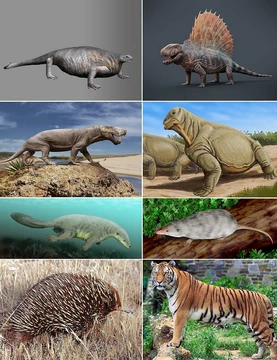
Cynodontia
Clade of therapsids that includes mammals and their extinct relatives.

Momotarou2012 Nobu Tamura ( http://spinops.blogspot.ca/ ) Smokeybjb Nobu Tamura · Public domain
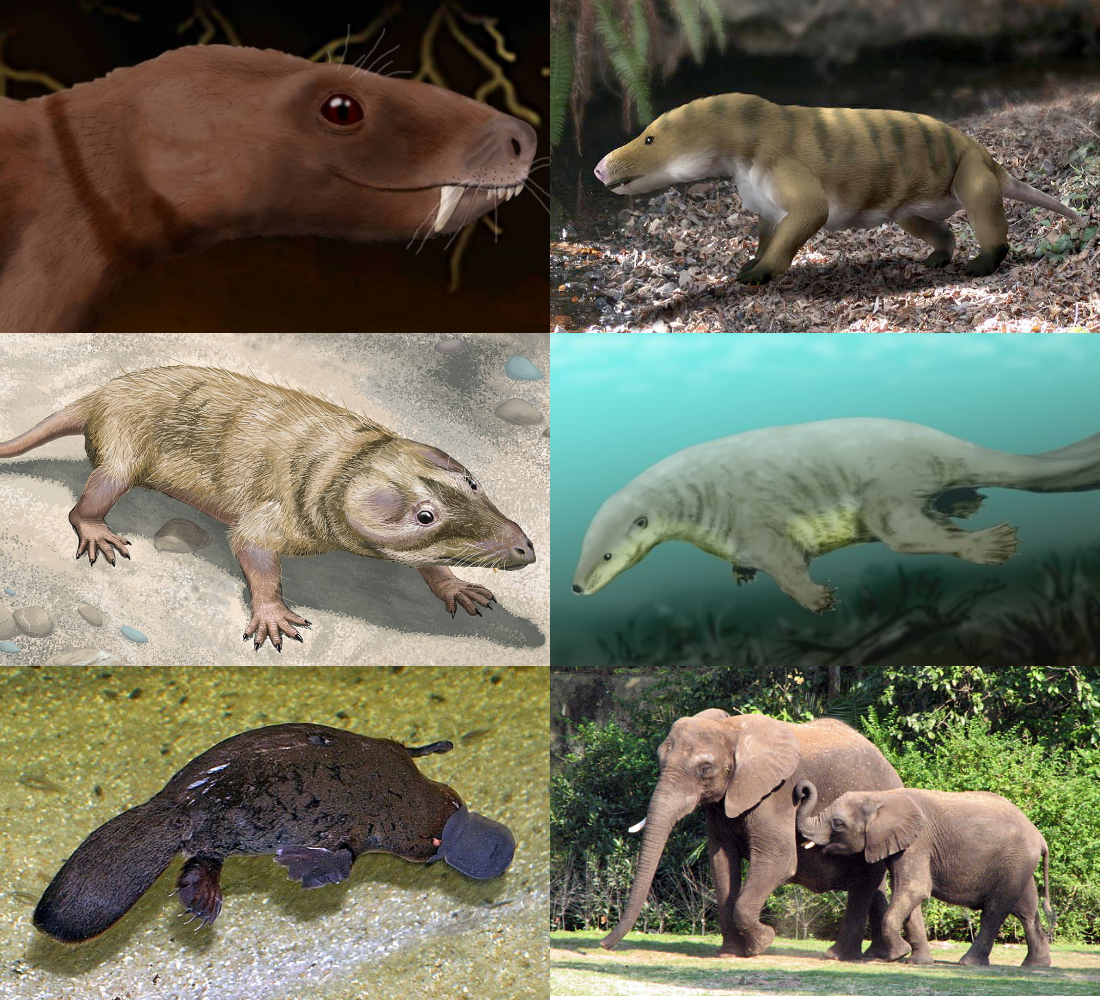
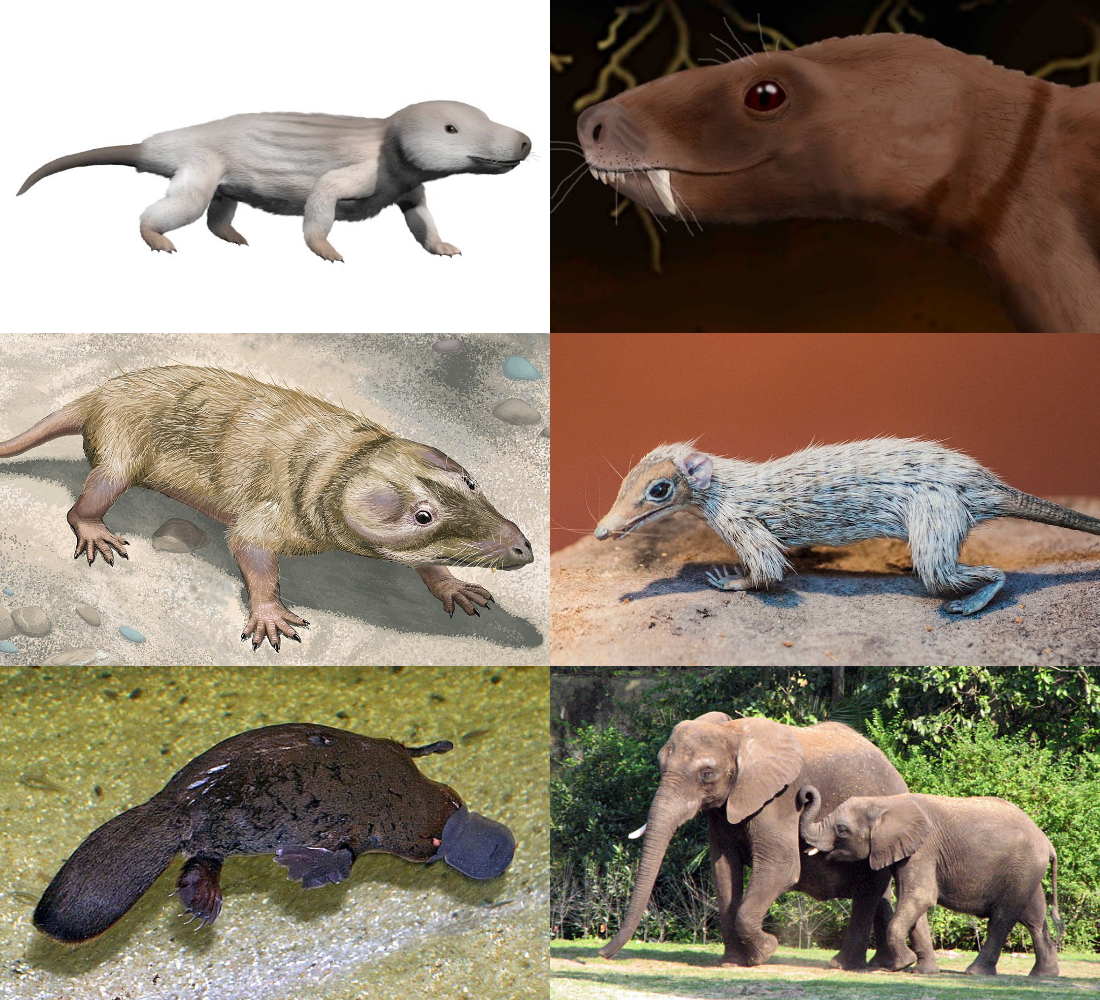
Mammals are cynodonts, as are their extinct ancestors and close relatives (Mammaliaformes), having evolved from advanced probainognathian cynodonts during the Late Triassic. Non-mammalian cynodonts occupied a variety of ecological niches, both as carnivores and as herbivores.
- clade
- Eutheriodontia
- key_characteristic
- Differentiated teeth, secondary palate, reduced jaw bones
Lore & Background
Early cynodonts have many skeletal characteristics of mammals: fully differentiated teeth, a bulging braincase, larger temporal fenestrae, and a secondary palate primarily comprising the maxillae and palatines. The dentary was the largest bone in their lower jaw. While early cynodonts likely laid eggs, derived cynodonts including mammaliaforms and early mammals are widely believed to have given live birth.
Reader's Guide
Cynodonts are significant as the direct ancestors of mammals, having evolved from advanced probainognathian cynodonts during the Late Triassic. They expanded rapidly in diversity after the Permian–Triassic extinction event, with peak disparity from the Induan to the Carnian and in the middle Norian. During their evolution, the number of jaw bones reduced, paving the way for bones of the jaw to migrate to the cranium as parts of the mammalian hearing system. The development of a secondary palate allowed chewing and breathing simultaneously, a characteristic present in all mammals. Only two groups of non-mammaliaform cynodonts existed beyond the end of the Triassic: the insectivorous Tritheledontidae (into the Early Jurassic) and the herbivorous Tritylodontidae (into the Early Cretaceous). Cynodonts are the only known synapsid lineage to have produced aerial locomotors, with gliding known in haramiyidans and various mammal groups.
Did You Know?
- Cynodonts are one of the few synapsid lineages known to have produced aerial locomotors, including gliding and flight, though gliding has also been proposed for some non-cynodont therapsids and possibly varanopids.
- Epipubic bones are known primarily from mammaliaforms and early mammals, not from most non-mammalian cynodonts, and their presence in other synapsids is not well-supported.
Gallery
Frequently Asked Questions
What is Cynodontia in the Prehistoric Synapsids series?
Cynodontia is the major therapsid clade that contains all living mammals together with their now-vanished close relatives, the mammaliaforms. It nests inside the broader group Eutheriodontia and represents one of the most consequential branches in the entire synapsid family tree.
What are Cynodontia's signature anatomical traits?
Fans typically point to three hallmarks: teeth that split into clearly distinct functional types, the emergence of a secondary palate, and a streamlining of the jaw by losing several bones. Together these features mark the transition away from the more generalized therapsid skull.
What ecological niches did non-mammalian cynodonts occupy?
Rather than being a single body-plan, non-mammalian cynodonts spread across a wide range of roles, with some lineages hunting as carnivores and others grazing as herbivores. That breadth of niche use made them one of the most ecologically versatile synapsid groups of the Triassic.
How exactly did mammals arise within Cynodontia?
During the Late Triassic, a lineage of advanced probainognathian cynodonts gave rise to the first true mammals, splitting the mammaliaform branch off from its non-mammalian cousins. In other words, mammals are not outside Cynodontia—they are the surviving tip of one of its many sub-branches.
Why is Cynodontia considered the pivotal link in synapsid evolution?
It is the anatomical bridge between the more reptile-like early therapsids and the fully mammalian condition, showing stepwise changes in jaw structure, tooth specialization, and palate development. Without this clade, the evolutionary story from early synapsids to modern mammals simply has no connecting thread.
More in Prehistoric Synapsids 1-19
Spotted an error? Know more?
This is a living reference — every entry is fact-audited, and reader corrections feed straight into our audit queue. Suggest an edit · See this site's audit record