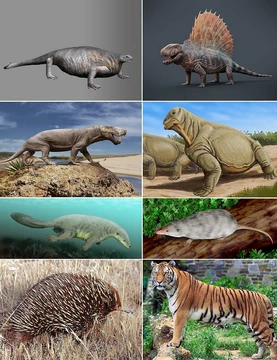
Dinocephalia
Large-bodied therapsids of the Middle Permian, apex predators and megaherbivores.

Andrew Allen Depicted place: Greenvale VIC 3059, Australia ( 37°38′49″S 144°51′5 · CC BY 4.0
Dinocephalians included carnivorous (Anteosauria), as well as herbivorous and omnivorous (Tapinocephalia) forms, serving as both dominant megaherbivores and apex predators. Many species had thickened skulls with many knobs and bony projections. Dinocephalian fossils are known from Russia, China, South Africa, Zimbabwe, and Tanzania.
- Fossil locations
- Russia, China, South Africa, Zimbabwe, Tanzania
Lore & Background
Dinocephalians were generally large in size, and some were the largest animals of the Permian period, and the first synapsids to reach a body size around one tonne. Their skulls and lower jaws are unified by several characters, including the loss of the vomerine process of the premaxilla, enlarged temporal fenestra, and a long posteriorly directed spur-like process of the premaxilla between the nasal bones. Most dinocephalians also developed a thickened and ornamented skull roof and braincase, sometimes with horn-like projections, making their skulls highly strong and resistant to fracture.
Reader's Guide
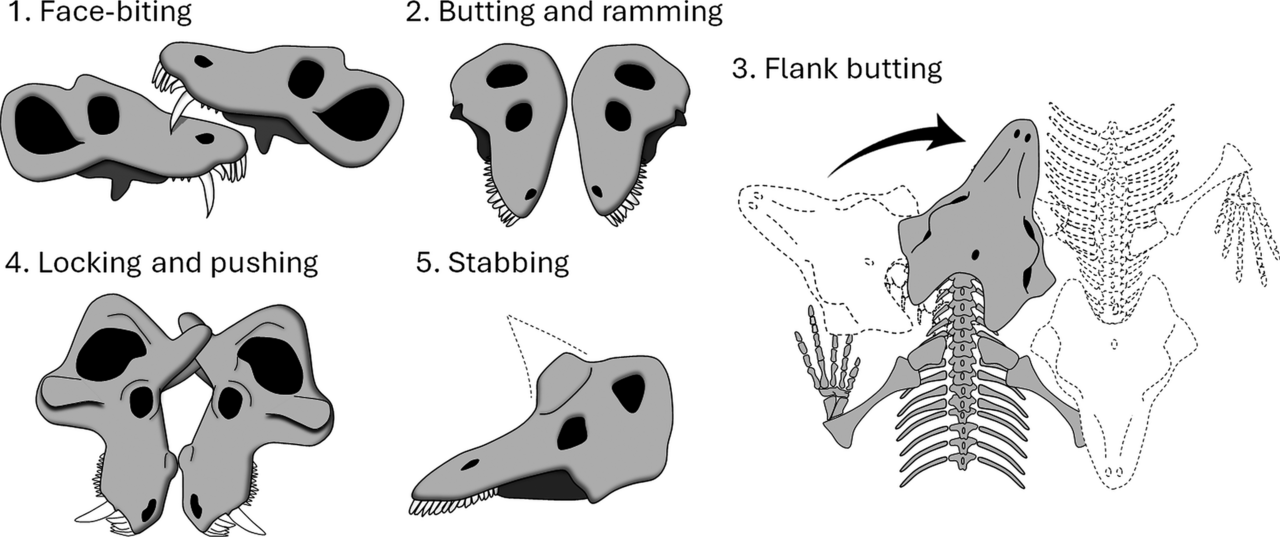
Dinocephalians were the first non-mammalian synapsids to be scientifically described, with remains first reported in the 19th century from Russia and South Africa. During the Middle Permian, tapinocephalian and anteosaurian dinocephalians were dominant megaherbivores and apex predators respectively. It has been disputed as to whether some dinocephalians like titanosuchids and tapinocephalids were semi-aquatic like hippopotamuses. It has been widely suggested that tapinocephalids engaged in head-butting, and other dinocephalians may have also engaged in head butting, as well as biting and/or head interlocking or swiping combat. Many dinocephalians appear to have had an enlarged brain cavity, which may have hosted thick protective tissue surrounding the brain, leading some authors to suggest at least some dinocephalians had complex, gregarious social behaviour. Their fossils are known from Russia, China, Brazil, South Africa, Zimbabwe, and Tanzania.
Did You Know?
- The first non-mammalian therapsid to be scientifically described was Rhopalodon in 1841, predating dinocephalians like Estemmenosuchus.
- The dinocephalian Estemmenosuchus is one of the few non-mammalian therapsids to have preserved skin impressions, showing scaleless skin covered in small tubercles.
- Some dinocephalians had over 60 caudal vertebrae in the tail, while others like Tapinocaninus had at least 20 caudal vertebrae, as established in scientific literature (e.g., Rubidge, 1991).
Gallery
Frequently Asked Questions
What is Dinocephalia?
Dinocephalia is a group of large-bodied therapsids that thrived during the Middle Permian period. They filled ecological roles as both apex predators and dominant megaherbivores, making them among the earliest top-tier land vertebrates.
What did Dinocephalia eat?
The group divided into two main dietary strategies: the carnivorous Anteosauria, which hunted as apex predators, and the herbivorous or omnivorous Tapinocephalia, which dominated as megaherbivores. This meant dinocephalians sat at the top of the food chain in both predator and grazer roles.
Where have Dinocephalia fossils been found?
Fossil remains of dinocephalians have been recovered from five countries: Russia, China, South Africa, Zimbabwe, and Tanzania. This broad geographic spread shows they were a globally successful group during their time.
What are the distinctive skull features of Dinocephalia?
Many species possessed notably thickened skulls studded with bony knobs and projections. These elaborate cranial structures are thought to have served in head-butting or social display behaviors among individuals.
When did Dinocephalia live?
Dinocephalians were active during the Middle Permian, making them one of the earliest groups of large, ecologically dominant land vertebrates. Their reign as apex predators and megaherbivores predates the rise of dinosaurs by tens of millions of years.
More in Prehistoric Synapsids 1-19
Spotted an error? Know more?
This is a living reference — every entry is fact-audited, and reader corrections feed straight into our audit queue. Suggest an edit · See this site's audit record