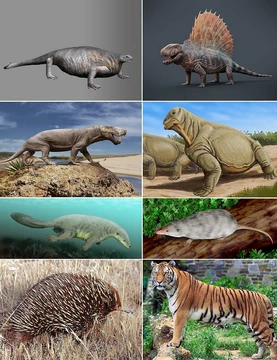
Therapsida
Major synapsid group that includes mammals and their ancestors.

Therapsida is a major group of eupelycosaurian synapsids that includes mammals, their ancestors, and close relatives. Many defining traits of modern mammals originated within early therapsids, including differentiated teeth (incisors, canines, molars), a more upright quadrupedal posture, and increased neck flexibility. They split from their closest relatives, the carnivorous Sphenacodontidae (including Dimetrodon), during the Late Carboniferous or earliest Permian, though their early evolutionary history is obscure and lacks confirmed fossils from the Early Permian, leaving a substantial ghost lineage.
- field
- Paleontology
- known_for
- Ancestral group that gave rise to mammals; first synapsids with upright posture and differentiated teeth
- time_range
- Late Carboniferous or earliest Permian to present (only mammals survive)
- major_clades
- Dinocephalians, anomodonts, biarmosuchians, theriodonts (including cynodonts, which gave rise to mammals)
Lore & Background
Therapsids replaced pelycosaurs as the dominant large land animals during the Guadalupian (Middle Permian) through to the Early Triassic. Their legs were positioned more vertically beneath their bodies than the sprawling legs of reptiles and pelycosaurs, and their feet were more symmetrical, indicating a more mammal-like gait. The teeth of therapsids are ancestrally differentiated into incisor, canine, and postcanine teeth, with all therapsids other than Raranimus possessing only one pair of canines in the upper jaw.
Reader's Guide
Therapsids are significant as the clade that includes mammals and their immediate ancestors, marking a key transition in vertebrate evolution. Their skeletal changes—limbs under the body, differentiated teeth, flexible necks—set the stage for mammalian traits. After the Permian–Triassic extinction event, therapsids declined relative to archosaurian sauropsids, but cynodonts gave rise to mammals in the Late Triassic around 225 million years ago, the only therapsid clade to survive beyond the Triassic. Dicynodonts, the only other therapsid group to reach the Late Triassic, became extinct by its end. The last non-mammaliaform cynodonts, the Tritylodontidae, survived into the Early Cretaceous. The physiology of non-mammalian therapsids is poorly understood; evidence from oxygen isotopes suggests most Permian therapsids were ectotherms, with endothermy evolving convergently in dicynodonts and cynodonts near the end of the Permian. The evolution of fur is also poorly known, with the most basal synapsids showing unambiguous fur being docodonts, which are mammaliaforms closely related to crown-group mammals.
Did You Know?
- Therapsids split from Sphenacodontidae (including Dimetrodon) during the Late Carboniferous or earliest Permian.
- The teeth of therapsids are ancestrally differentiated into incisors, canines, and postcanine teeth.
- A preserved embryo of the dicynodont Lystrosaurus suggests non-cynodont therapsids likely laid eggs.
- The only therapsid clade to survive beyond the Triassic is the cynodonts, which gave rise to mammals.
Frequently Asked Questions
What is Therapsida?
Therapsida is a major lineage of synapsids that encompasses all mammals, their direct ancestors, and several extinct sister groups. It represents the branch of the synapsid family tree that ultimately produced the only surviving members of the broader group.
What traits define Therapsida?
Early therapsids are recognized for developing differentiated teeth (separate incisors, canines, and molars), a more erect limb posture, and greater neck mobility compared to their pelycosaurian relatives. These innovations laid the groundwork for the mammalian body plan that followed.
When did Therapsida first appear?
The group is thought to have diverged from its closest relatives, the sphenacodontids such as Dimetrodon, during the Late Carboniferous or the very earliest Permian. Confirmed Early Permian therapsid fossils, however, are scarce, leaving a notable gap in the fossil record.
What major clades belong to Therapsida?
The lineage is traditionally divided into dinocephalians, anomodonts, biarmosuchians, and theriodonts. It is within the theriodonts—specifically the cynodonts—that the first true mammals eventually evolved.
Why is Therapsida important in synapsid evolution?
Therapsida is the critical transitional branch that bridges pelycosaur-like ancestors and modern mammals. Without this group, the key anatomical and physiological innovations that define mammals today would have no evolutionary pathway.
More in Prehistoric Synapsids 1-19
Spotted an error? Know more?
This is a living reference — every entry is fact-audited, and reader corrections feed straight into our audit queue. Suggest an edit · See this site's audit record