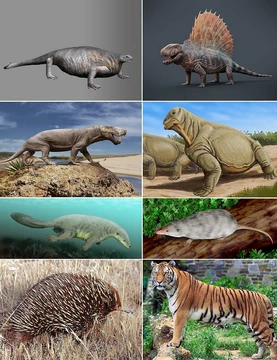
Synapsida
Clade including mammals and their extinct relatives.

Synapsida is a diverse group of tetrapod vertebrates that includes all mammals and their extinct relatives. It is one of the two major clades of Amniota, the other being Sauropsida (which includes all extant reptiles and birds). Synapsids are characterized by a single lower temporal fenestra, an opening low in the skull roof behind each eye socket, which allowed for the attachment of larger jaw muscles and a more efficient bite. The earliest synapsids appeared towards the end of the Carboniferous, around 315 to 307 million years ago, and they were the largest terrestrial vertebrates in the Permian period, dominating land predators of the late Paleozoic and early Mesozoic.
- Earliest appearance
- End of the Carboniferous, around 315 to 307 million years ago
- Dominant period
- Permian (299 to 251 mya)
- Key feature
- Single lower temporal fenestra
- Sister group
- Sauropsida
- Extant members
- Mammals (roughly 6,800 species)
- Notable extinct groups
- Pelycosaurs, therapsids (including dicynodonts and eutheriodonts)
Lore & Background
Synapsids evolved from basal amniotes (reptiliomorphs) historically called 'reptiles,' leading to non-mammalian synapsids being described as mammal-like reptiles or pelycosaurs in classical systematics. These paraphyletic terms have fallen out of favor, as it is now known that all extant reptiles are more closely related to each other and birds than to synapsids. Modern alternatives include stem mammals, proto-mammals, paramammals, or pan-mammals. Most lineages of pelycosaur-grade synapsids were replaced by the more advanced therapsids at the end of the Early Permian, a transition known as Olson's Gap/Extinction.
Reader's Guide
Synapsida represents a major branch of amniote evolution, distinct from sauropsids (reptiles and birds). Their single lower temporal fenestra, once thought unique, is now known to also appear in many primitive sauropsids, suggesting it may have been present in the last common ancestor of both clades. Synapsids were the dominant land predators of the Permian and early Triassic, with groups like eupelycosaurs (e.g., Dimetrodon) and theriodonts (e.g., Moschorhinus) as apex predators. Their diversity was severely reduced by the Capitanian and Permian–Triassic extinction events, with only dicynodonts and eutheriodonts surviving into the Triassic. After the Cretaceous–Paleogene extinction event, synapsids (as mammals) rose to dominance again in the Cenozoic. The shift from paraphyletic terms like 'mammal-like reptiles' to cladistic classification underscores that synapsids are a monophyletic sister taxon of sauropsids, not part of the reptile lineage.
Did You Know?
- Synapsids have a single lower temporal fenestra, an opening low in the skull roof behind each eye socket, which allowed for larger jaw muscles and a more efficient bite.
- The earliest synapsids appeared towards the end of the Carboniferous, around 315 to 307 million years ago.
- Non-mammalian synapsids were historically called mammal-like reptiles or pelycosaurs, but these terms are now considered outdated.
- After the Permian–Triassic extinction event, the dicynodont Lystrosaurus made up as much as 95% of all land species at one time.
Frequently Asked Questions
Who is Synapsida?
Synapsida is a major clade of tetrapod vertebrates that encompasses all living mammals along with their numerous extinct relatives. It stands as one of the two great branches of Amniota, the other being Sauropsida.
What is Synapsida's signature feature?
Every synapsid skull bears a single lower temporal fenestra, an opening positioned low behind the eye socket. This structural trait made room for bigger jaw muscles, granting a stronger and more efficient bite than their sauropsid counterparts.
When did Synapsida first appear?
The earliest synapsids show up near the close of the Carboniferous, roughly 315 to 307 million years ago. They went on to dominate terrestrial ecosystems throughout the Permian, from about 299 to 251 million years ago.
Who are Synapsida's closest relatives?
Synapsida's sister group is Sauropsida, the clade that gives rise to all extant reptiles and birds. Together, these two lineages account for every living amniote on Earth.
Why is Synapsida important?
Synapsida is the lineage that ultimately produced every one of the roughly 6,800 mammal species alive today. Its extinct members—pelycosaurs, dicynodonts, eutheriodonts, and other therapsids—form a crucial bridge in the story of how mammals came to be.
More in Prehistoric Synapsids 1-19
Spotted an error? Know more?
This is a living reference — every entry is fact-audited, and reader corrections feed straight into our audit queue. Suggest an edit · See this site's audit record