Frequently Asked Questions
The most-asked questions about prehistoric synapsids.
What exactly are synapsids?
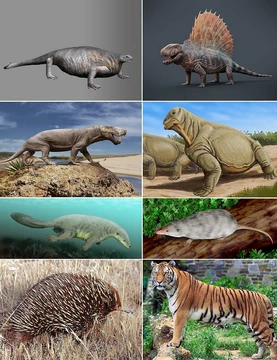
Synapsids are a major lineage of tetrapod vertebrates defined by having a single opening (temporal fenestra) behind each eye socket in the skull. This group spans from the Late Carboniferous, roughly 312 million years ago, to the present day, and includes all mammals along with their numerous extinct relatives.
Are synapsids the same as 'mammal-like reptiles'?
No—modern paleontology rejects that label because synapsids are not reptiles at all; they form a separate branch on the tetrapod family tree that diverged before the amniote split into synapsids and sauropsids. The old 'mammal-like reptile' term is now considered misleading and has been largely abandoned in scientific literature.
What is Dimetrodon and why is it so famous?
Dimetrodon is a Late Carboniferous pelycosaur from North America, best known for its large dorsal sail supported by elongated neural spines. It is one of the most recognizable prehistoric vertebrates in popular culture, though it is neither a dinosaur nor a true therapsid.
What distinguishes therapsids from earlier pelycosaurs?
Therapsids represent a more derived subgroup of synapsids that appeared in the Early Permian, characterized by a more mammal-like jaw joint, differentiated teeth (incisors, canines, postcanines), and a partially upright limb posture. They gave rise to cynodonts and ultimately to mammals, whereas pelycosaurs are generally regarded as a more basal, stem-level group.
What are dicynodonts?
Dicynodonts are a diverse group of mostly herbivorous therapsids that dominated Late Permian and Early Triassic ecosystems, recognizable by their beak-like rostrums and typically only two pairs of functional teeth, which gives the group its name. They include some of the largest non-avian land animals of their time, such as Kannemeyeria and Placerias.
What are gorgonopsids and why do fans love them?
Gorgonopsids were a family of carnivorous therapsids from the Late Permian of Africa, built for speed with large canines, a deep skull, and a long, low body. They are often called the 'tyrannosaurs of the Permian' in fan communities because of their apex-predator niche, though they are far smaller and morphologically distinct from true theropod dinosaurs.
How did synapsids eventually give rise to mammals?
Through roughly 100 million years of gradual evolution in the Permian and Triassic, therapsids—especially the cynodont subgroup—developed features like a secondary palate, probable fur (inferred from hair-follicle structures), and endothermy. The first true mammals, small shrew-like cynodonts, appear in the fossil record in the Late Triassic, around 225 million years ago.
What is a temporal fenestra and why does it matter for classification?
A temporal fenestra is an opening in the skull behind the eye socket that reduces weight and provides attachment points for jaw and neck muscles. The number and arrangement of these openings is a key diagnostic feature: synapsids have one per side, diapsids (like crocodiles and lizards) have two, and anapsids traditionally have none.
Where should a complete beginner start if they want to understand synapsid evolution?
A good entry point is to first learn the broad split between synapsids and sauropsids in the Early Permian, then follow the pelycosaur → therapsid → cynodont → mammal lineage step by step. Starting with a single well-known animal like Dimetrodon or a gorgonopsid and tracing its relatives forward and backward in time helps build the bigger picture.
Are there any synapsids still alive today?
Yes—every living mammal, from bats and whales to humans, is a synapsid, making the group the only prehistoric synapsid lineage that survived the Permian–Triassic and later mass extinctions. In that sense, the entire rest of the clade is represented by the fossil record, while you are looking at a living synapsid right now.